
Temperature and Humidity Monitoring for Pharmacies
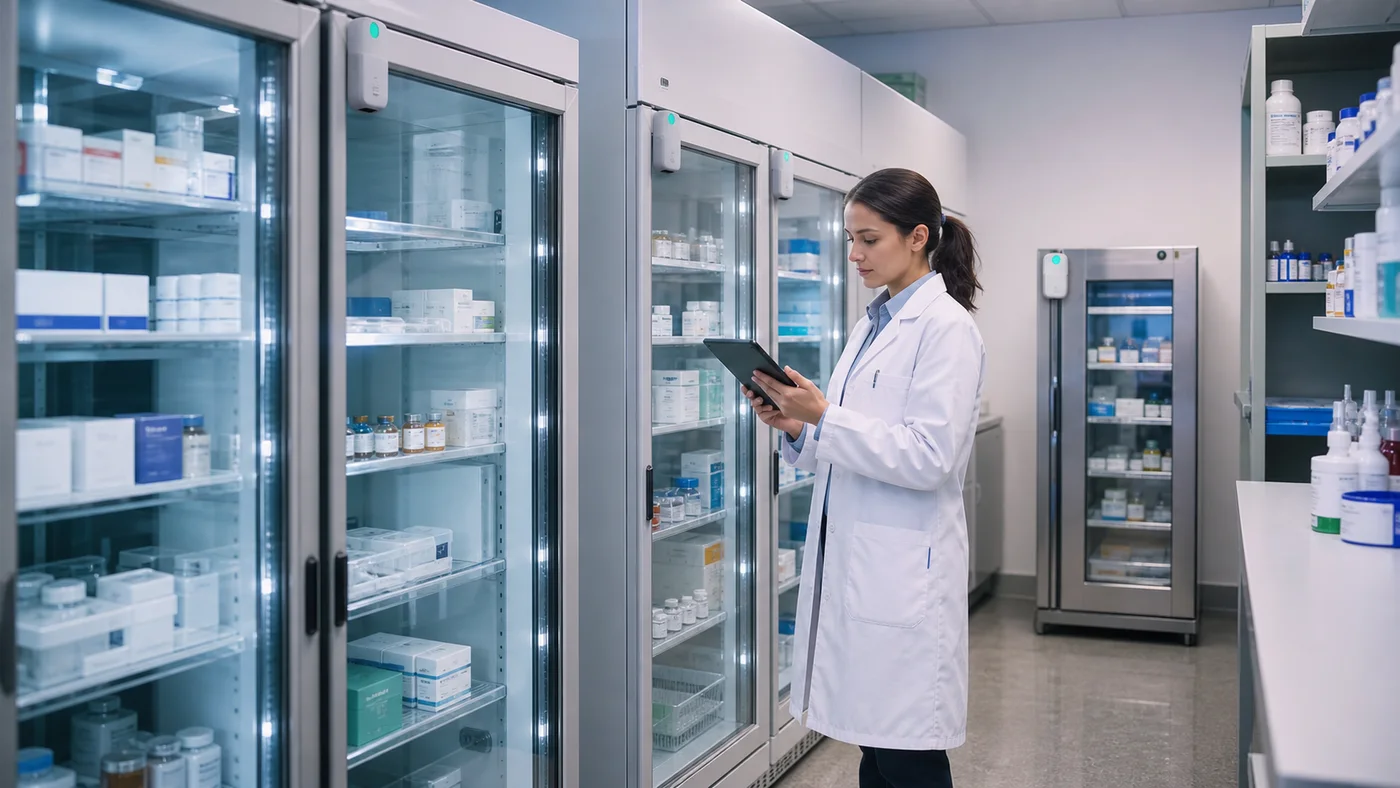
Pharmacies may manage several temperature-sensitive environments, including medication refrigerators, freezers, controlled storage rooms, and incubators used in applicable compounding, testing, or controlled processes. A useful monitoring program connects each environment to its operating requirement, assigned equipment, alert workflow, and condition history. Humidity should be monitored when the product, process, facility procedure, or applicable requirement calls for it—not assumed for every refrigerated medication.
Start with the Product and Operating Requirement
Do not begin with a universal temperature or humidity range. Review manufacturer labeling, product information, written procedures, contractual obligations, and applicable requirements, then document which condition must be monitored and who owns the decision.
- Record the approved temperature range for each product group or controlled environment.
- Identify whether relative humidity, light, or another condition is relevant.
- Define the permitted exposure duration or excursion logic when available.
- Document the authoritative source and responsible owner for every threshold.
Map Every Controlled Environment
Create an equipment and location register before selecting sensors. Assign each refrigerator, freezer, medication room, and applicable incubator a clear identity so readings, alerts, service events, and response notes remain connected to the right environment.
- Record the equipment or location name and unique identifier.
- Identify the products or processes supported by that environment.
- Document the normal operating range and known risk points.
- Review door activity, loading patterns, backup power, and after-hours access.
Match the Measurement Method to the Application
Evaluate the sensor for measurement range, accuracy, resolution, response behavior, placement, logging interval, battery life, and environmental durability. Air temperature, buffered temperature, surface temperature, and internal product temperature are not interchangeable. The selected method should match the decision the pharmacy needs to make.
- Confirm whether the sensor represents ambient air or a product-simulating condition.
- Validate placement in the actual refrigerator, freezer, room, or incubator.
- Define calibration documentation and recalibration expectations.
- Include humidity only where the requirement and sensor configuration support it.
Design Alerts Around Response—not Noise
An alert is useful only when its threshold, delay, recipients, and response steps are defined. Brief door openings may require different treatment from a sustained equipment problem, and after-hours events need an explicit escalation path.
- Define the threshold and any permitted delay or excursion duration.
- Assign primary, backup, and after-hours recipients.
- Specify required acknowledgement and response notes.
- Include power, battery, connectivity, and sensor-status exceptions.
Preserve Reviewable Condition History
Connect readings and events to the identified equipment or location. A reviewable record can help teams understand when an excursion began, how long it lasted, who responded, and what actions were recorded. Retention and export requirements should be defined by the organization.
- Retain timestamped readings and threshold events.
- Connect alert acknowledgements and corrective-action notes.
- Make sensor, battery, and connectivity status visible.
- Align exports or summaries with internal review procedures.
Evaluate a Pharmacy Monitoring System Before Ordering
Give potential suppliers a list of the storage equipment, measurement requirements, and locations you need to monitor. Compare proposed systems against that same scope and ask for a demonstration of a reading, an alert, and the associated history.
- Confirm the proposed sensor configuration and available calibration documentation against your documented requirements.
- Check gateway placement and connectivity inside the actual storage environment.
- Ask which notification channels are supported and how staff can identify the equipment behind an alert.
- Confirm how communication gaps are displayed and what records can be reviewed or exported.
- Separate hardware, platform, setup, and support costs so the full deployment can be compared.
Validate the Workflow with a Focused Pilot
Start with a representative group of environments rather than every unit at once. Compare readings with the accepted reference method, test normal door and loading activity, simulate an alert and communication failure, and review whether the resulting history supports the pharmacy workflow. Monitoring data informs investigation; product disposition remains with the authorized pharmacy, quality team, manufacturer, or other responsible party.
- Select a representative refrigerator, freezer, room, or applicable incubator.
- Verify sensor placement and communication coverage.
- Test alerts during staffed and after-hours periods.
- Document acceptance criteria and the rollout recommendation.
Credible pharmacy monitoring starts with the storage requirement: map each controlled environment, qualify the right measurements, and define what happens when conditions move outside the approved range.
Effective pharmacy monitoring is application-specific. Connecting qualified measurements, equipment identity, alert ownership, and condition history can help a pharmacy recognize environmental risks earlier and investigate events with better context. SNAPTAG can help scope and validate the monitoring workflow, but it does not replace product labeling, pharmacy procedures, calibration requirements, professional judgment, or applicable regulations.
Sources & Further Reading
Authoritative references used to frame this guide. Confirm the requirements that apply to your operation and jurisdiction.
- 〈1079.3〉 Monitoring Devices—Time, Temperature, and HumidityUnited States Pharmacopeia
- Model Guidance for the Storage and Transport of Time- and Temperature-Sensitive Pharmaceutical ProductsWorld Health Organization
- Vaccine Storage and Handling ResourcesCenters for Disease Control and Prevention
- Expiration Dating and Stability Testing for Human Drug ProductsU.S. Food and Drug Administration
Apply This Guide to Your Operation
Discuss the environment, workflow, conditions, and success criteria you need to validate.
Discuss a Pharmacy Monitoring PilotExplore Pharmaceutical Cold Chain